How can it be determined whether a damaged component/system can still be used safely?
This question is becoming increasingly important, particularly in the case of ageing infrastructure. The following article explains how the systematic assessment of damage enables well-founded decisions about continued usability.
This method goes far beyond merely identifying defects. It provides concrete recommendations for action for owners and operators that take into account both safety and economic efficiency.
- A systematic assessment method enables well-founded statements about the remaining service life of damaged components/systems
- Connection between technical damage assessment and practical recommendations for action for those responsible
- Consideration of both technical and economic aspects in the condition assessment
- Particular relevance for ageing infrastructure and existing building stock
- Basis for safe and economically sensible decisions about continued use
- Holistic understanding of the component/system condition through structured analysis procedures
What is meant by fitness-for-service assessment in failure analysis
When a component/system is damaged, the question immediately arises: Can it still be used? This central question is at the heart of fitness-for-service assessment. The damage investigation provides the necessary information to make this decision on a scientific basis.
The assessment goes far beyond a simple visual inspection. It combines various investigation methods on site with precise laboratory analyses. This produces a complete picture of the damage situation.
Basic definition and classification of the concept
The assessment takes into account several important points. First, the actual usage requirements are analysed. Then the remaining service life is estimated. Finally, the safety reserves of the structure are evaluated.
The damage investigation records the following elements:
- Type and extent of the damage identified
- Effects on the load-bearing capacity of the structure
- Influence on the intended use of the component/system
- Structural and material-related aspects
This comprehensive consideration makes fitness-for-service assessment a valuable tool. It supports well-founded decisions in maintenance management. Builders and engineers receive clear recommendations for action.
Distinction from classical damage assessment
The traditional damage assessment documents the current condition of a component/system. It lists existing defects and describes them in detail. This approach provides an important inventory. Classical damage assessment can contain prognostic elements (e.g. durability forecasts), but is not necessarily decision-oriented.
Fitness-for-service assessment, however, goes one decisive step further. It answers the practically most important question: Can the component/system continue to be used safely despite the damage identified? This forward-looking perspective makes the difference.
- Consideration of specific loads in operation
- Evaluation of load-bearing capacity under real conditions
- Assessment of hydraulic and structural influences
- Forecast of the further development of the damage
While classical damage assessment describes the actual condition, fitness-for-service assessment provides answers for the future. It enables economic decisions between rehabilitation and new construction. The method has become established in component/system maintenance.
Fitness for Service as an international standard
Fitness for Service describes a systematic procedure for assessing damaged or aged plants. This approach was developed internationally and has gained acceptance worldwide. It provides standardised methods for assessing continued safe usability under real operating conditions.
The concept combines various technical disciplines. Engineering calculations form the foundation of the analysis. Materials testing provides important parameters about the condition of the building material. Risk assessments round off the overall picture.
The Fitness for Service methodology comprises several steps:
- Collection of all relevant damage information
- Performance of load-bearing-oriented assessments
- Analysis taking into account the actual stress
- Preparation of well-founded recommendations for action
These standardised procedures create comparability and quality. The Fitness for Service standards are continuously developed further. They take into account new findings from research and practice.
In Germany, this approach is becoming increasingly important. It is used in a methodically adapted form, especially for infrastructure structures such as bridges and tunnels. The method enables an objective assessment and reduces uncertainties in decision-making.
Why assessing continued usability is so important
The importance of a professional assessment is becoming ever greater in today’s construction practice. Many structures in Germany have already reached or exceeded an age of 100 years. A growing maintenance backlog and deteriorating conditions pose major challenges.
The age structure of the infrastructure requires new approaches. Scarcity of resources makes it necessary to prioritise maintenance and new construction measures. The structural engineering assessment helps to make smart decisions.
Structures with relevant deficits require priority attention. A well-founded assessment shows which measures are really necessary. This enables an efficient use of available resources.
Safety aspects come first
For damaged structural elements, safety has top priority. The assessment must clarify whether existing damage poses dangers to users or the public. Various scenarios are carefully examined.
The behaviour under normal loads plays an important role. Reserves for exceptional loads are equally relevant. Load-bearing capacity is a central benchmark for assessment.
The analysis takes into account possible failure scenarios. Could a failure occur, and if so, with what warning time? These questions are decisive for responsible decisions.
Usage safety also includes consideration of damage progression. Some damage remains stable over the years. Other damage develops continuously and requires attention.
A well-founded assessment forecasts the expected behaviour. This enables timely measures before critical conditions are reached. Preventive action protects people and preserves building stock.
Economic benefit through targeted measures
The complete replacement of structural elements causes considerable costs. A careful assessment can show that continued use with limited repair measures is possible. This saves financial resources, time and resources.
In many cases, the service life can be considerably extended through targeted repairs. Adapted usage concepts offer additional scope. The assessment helps to avoid unnecessary interventions.
At the same time, necessary measures are precisely identified. This leads to optimised investment decisions. The efficient use of resources benefits all parties involved.
The economic advantages go beyond direct cost savings. Shorter construction times mean fewer usage restrictions. Components/systems remain available longer without the need for extensive replacement measures.
A professional technical assessment creates planning certainty. Budgets can be set more realistically. Surprises during implementation are minimised.
Legal protection for those responsible
Owners and operators of structures as well as components/systems bear responsibility for traffic safety. Statutory requirements demand that structures comply with the recognised rules of technology. Usage safety must be guaranteed at all times.
A professional assessment documents that this obligation is being fulfilled. It provides comprehensible justifications for the decisions made. This creates important legal certainty in everyday life.
In the event of damage, the documentation serves as important evidence. It also demonstrates responsible action during official inspections. The systematic approach is presented transparently.
The legal bases comprise various standards and regulations. The building regulations of the federal states define requirements for structural stability. Technical rules and regulations specify these requirements for practice.
A well-founded assessment takes into account all relevant requirements. It shows where action is needed and where there is room for manoeuvre. This clarity helps in communicating with authorities and other parties involved. It does not replace an official structural inspection (e.g. DIN 1076), but complements it.
Methods and procedures of structural engineering assessment
Modern technologies and classical procedures complement each other in the systematic recording of the condition of structures. Building damage diagnosis uses a broad spectrum of investigation methods that enable precise statements about the current condition. The available instruments range from laboratory analysis of individual samples to assessment of the entire load-bearing structure.
Fundamentals of materials analysis
Materials testing forms the foundation of any well-founded assessment. Without precise knowledge of the building material properties, the load-bearing capacity cannot be reliably estimated. That is why every failure analysis begins with the investigation of the materials used.
In the case of concrete structures, drill cores are taken and examined in the laboratory. These samples provide information about compressive strength, density and chemical composition. Carbonation depth and chloride content are also determined, as they directly influence durability.
Steel components require specific tests to determine mechanical properties. Tensile strength and ductility show whether the material still has the required performance. Corrosion damage is examined microscopically in order to quantify the extent of the damage.
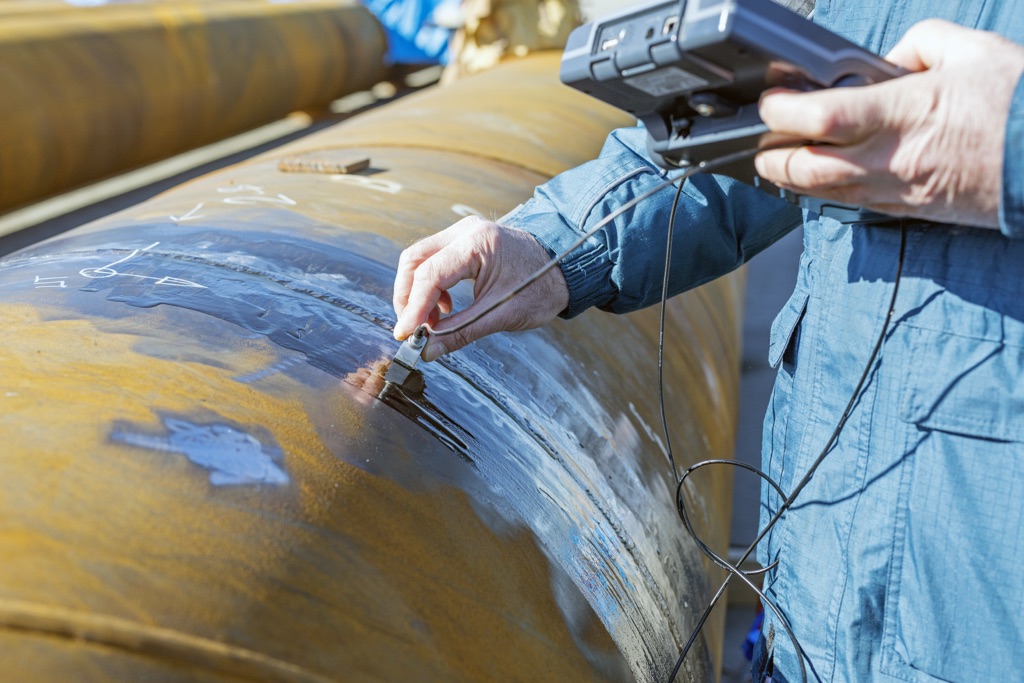
Non-destructive testing methods supplement materials testing through investigations without removal of material. These methods enable large-area recording and provide valuable additional information:
- Ultrasonic measurements detect internal voids, cracks and delaminations in the depth of the component
- Radar methods reveal hidden structures such as reinforcement layers or conduits in the component
- Thermography records moisture distributions and thermal bridges on surfaces
- Potential field measurements locate corrosion-prone areas in reinforced concrete
This combination of destructive and non-destructive procedures produces a complete picture of the material properties. The findings obtained feed directly into the assessment of the remaining load-bearing capacity and form the basis for all further analyses.
Holistic assessment of the load-bearing structure
The structural damage investigation considers the structure as an interconnected system. Individual structural elements act together, which is why the analysis must capture the entire load-bearing behaviour. Vibration-based procedures (e.g. modal analyses) capture changes in natural frequencies, mode shapes and damping parameters as indicators of structural changes. Changes in these parameters are, however, not unambiguously damage-related and must always be interpreted in connection with temperature, boundary conditions and use.
The procedure is based on measuring the dynamic properties of the structure. Natural frequencies, mode shapes, damping values and vibration intensities characterise the current condition. Sensors register the acceleration of the vibrating structure in three-dimensional directions.
Load tests supplement the dynamic measurements through controlled tests under load. The structure is subjected to defined loads while deformations are continuously measured. These tests show the real load-bearing behaviour under practical conditions.
The procedure is carried out systematically according to a defined protocol. First, low loads are applied and gradually increased. The reaction of the structure is monitored at critical points. Elastic deformations indicate intact load-bearing capacity, while permanent deformations indicate damage.
Laboratory investigations supplement the on-site failure analyses through detailed materials testing. The combination of field measurements, load tests and laboratory results produces precise damage reports. These serve as a well-founded basis for decision-making for all parties involved.
The integration of all measurement results is carried out by comparison with theoretical calculations. Computer models simulate the load-bearing behaviour and are validated with the actual measured values. Deviations between theory and practice reveal concrete damage and enable its quantification.
This methodical approach in building damage diagnosis ensures a comprehensive and objective assessment. The spectrum ranges from microscopic materials analysis to assessment of the entire load-bearing structure. Only through this combination of various procedures does a complete and reliable picture of the current condition emerge.
From assessment to recommendation for action
Concrete recommendations for action for all parties involved emerge from the results of the investigation. The technical analysis provides important findings about the current condition. This information forms the basis for strategic decisions.
Reliable data enables dependable maintenance management. Fitness-for-service assessment in failure analysis creates clarity about necessary measures. Every step is documented and justified in a comprehensible manner.
Practical fields of application of building damage diagnosis
From residential buildings to large infrastructure projects – the fields of application are diverse. Fitness-for-service assessment proves its worth wherever structures show damage and decisions about their continued use have to be made. Each area places its own demands on the depth of analysis and the methods used.
Building construction and residential buildings
Residential buildings show the most diverse damage patterns over time. Cracks in load-bearing walls can be harmless or indicate serious problems. Soaked ceilings, corroded reinforcement or settlement damage require a precise assessment.
The assessment clarifies whether simple rehabilitation is sufficient or whether more extensive measures are necessary. In the case of older buildings, the question of the economic sense of modernisation often arises. The analysis of the building stock provides owners with clear recommendations for action and prevents costly bad investments.
The assessment is indispensable, especially in the case of planned changes of use or additional storeys. It examines whether the existing structure can bear additional loads. This creates well-founded bases for decision-making for all further planning steps.
Industrial plants and production facilities
Extreme conditions often prevail in industrial plants. High temperatures, chemical stresses, constant vibrations or exceptional loads place considerable strain on the building stock. Production plants are subject to continuous wear, which must be checked regularly.
The assessment determines precisely when structural elements have to be replaced and where repairs are still sufficient. Unplanned shutdowns cause considerable costs. A forward-looking analysis saves money and increases operational safety.
The investigation takes into account operation-specific requirements and develops tailored concepts.
- Evaluation of load-bearing capacity under operating loads
- Analysis of chemical effects on building materials
- Examination of vibration loads and fatigue phenomena
- Assessment of temperature-induced damage
Infrastructure such as bridges and tunnels
Infrastructure structures bear a special responsibility for safety and mobility. Bridges are exposed to enormous traffic loads every day and frequently show fatigue phenomena. Corrosion damage to steel girders or concrete spalling on carriageway slabs require precise assessments.
Modern procedures with vibration measurements record the current condition very precisely. These analyses show whether the load-bearing capacity still meets the requirements. The vibration behaviour provides information about hidden weak points in the structure.
Tunnels suffer from moisture exposure, frost damage or cracks in the vault. The assessment must be carried out particularly carefully here. Failures would have far-reaching consequences for traffic and the economy.
Roads and traffic areas are exposed to heavy loads every day. Damage such as cracks, settlements or rutting can have various causes. Improper installation, material defects or overloading lead to different damage patterns.
The failure analysis is carried out on site and supplemented by laboratory investigations. Precise damage reports serve as a basis for decision-making for builders, authorities or courts. A thorough analysis identifies the true causes and enables targeted repairs instead of cost-intensive complete rehabilitation.
Forensic engineering in complex damage cases
When structures or components/systems fail unexpectedly or exceptional damage occurs, forensic engineering is used. This specialised discipline resembles detective work. Experts reconstruct damage sequences, determine causes and assess responsibilities.
The analyses often serve as a basis for legal disputes or insurance cases. Forensic engineering combines all available investigation methods for a complete picture. Materials analyses, load simulations and document evaluations interlock.
The findings not only help in clarifying liability issues. They also provide valuable information for avoiding similar damage in the future. In this way, this form of failure analysis contributes to the continuous improvement of construction practice.