How can the highest quality standards be ensured in manufacturing when components are becoming ever more complex and tolerances ever tighter?
This article provides a comprehensive look at how modern precision metrology works and the benefits it offers to manufacturing companies. Today’s measuring systems capture not just simple dimensions, but map the complete topography of a workpiece in the shortest possible time. They operate autonomously, significantly reduce labour costs and guarantee a reproducibility that manual measurements could never achieve.
Surface and contour measurement now forms the backbone of quality assurance in the manufacturing industry. Structured functional surfaces with tight tolerances call for measuring solutions that work precisely, quickly and reliably. Modern technologies measure roughness, diameters and geometries on complex components efficiently and without human sources of error. In this way, companies dramatically increase their productivity in the measuring room while simultaneously safeguarding the highest technical standards.
- Modern measuring systems capture contour and surface features quickly, precisely and over the full area
- High-precision measuring technology maps the complete topography of complex workpieces in a short time
- Autonomous measuring methods eliminate operator influence and guarantee the highest reproducibility
- Efficient measuring solutions reduce labour costs through the absence of staff involvement during the process
- Structured functional surfaces with tight tolerances require specialised precision systems
- Reliable measuring technology forms the foundation for quality assurance in the manufacturing industry
Fundamentals of the metrological capture of geometry and surfaces
Accurately capturing the geometry and surfaces of components is a core task of industrial metrology. In manufacturing engineering, this is not simply about reading off measured values. Rather, the focus is on a systematic approach that delivers reproducible results and forms the basis for reliable quality statements.
High-precision measuring systems record the topography of a workpiece in a short time. They make it possible to determine macro-form deviations and to safeguard the quality of components. Various measuring methods work together here, each performing specific tasks and providing a comprehensive picture of component quality.
Metrology for contour, form, position and surface measurement in detail
Four central measuring methods form the foundation of geometric quality assurance and cover different testing requirements. Each measuring method concentrates on specific features of a workpiece and delivers important insights into its quality. The combination of these methods enables a complete assessment of components and reveals weak points in the manufacturing process.
Modern measuring technology today offers diverse solutions for different applications. Mobile measuring devices make it possible to take measurements directly at the place of production when the size of the workpiece requires on-site measurement. It becomes particularly practical when measurements are to be carried out directly in the production line without removing the workpiece.
Capturing component edges and profiles
Contour measuring instruments serve to determine macro-form deviations and accurately reproduce the external shape of a workpiece. They capture edges, profiles and the geometric outer contour with high accuracy. Particularly with components of complex shapes, even the smallest deviations have a major impact on functionality.
Optical contour measurement offers decisive advantages over conventional methods here. Non-contact capture protects sensitive surfaces from damage and considerably speeds up the measuring process. Optical systems work quickly, precisely and are ideally suited to inline quality control.
Contour and roughness measurement can be combined to create an all-rounder for every situation. This combination saves time and enables comprehensive analyses in a single measuring operation. Users benefit from reduced setup times and consistent measurement results.
Analysing roughness and texture
Roughness measurement is a central component of quality control and influences many functional properties. Surface condition has a direct effect on friction, wear, tightness and optical properties. Precise measurements of roughness guarantee that components reliably fulfil their intended function.
Modern surface measuring technology delivers not only one-dimensional values but areal 3D information about the topography. 3D surface measuring technology is used equally in industry and research and enables detailed analyses of the surface structure. This technology captures the finest details and visualises surface features clearly.
Optical surface measuring technology delivers quantitative, traceable characteristic values – quickly, robustly and precisely. In roughness measurement, various parameters are determined that describe different aspects of surface quality. Non-contact measurement protects sensitive workpiece surfaces and significantly speeds up the testing processes.
Monitoring the positioning of component elements
Position testing monitors the spatial positioning of component elements such as bores, threads or mating surfaces. It ensures that all components are correctly aligned with one another during assembly. Faulty positioning leads to assembly problems and impairs the functionality of the end product.
In position testing, distances, angles and relative positions of various features are measured. These measurements are particularly important for assemblies with tight tolerances. Precise position data enable safe assembly and guarantee the functionality of complex systems.
Modern measuring methods capture position parameters without contact and at high speed. Position testing reveals deviations early and prevents costly rework or scrap. Systematic position checks improve process stability and increase the yield in series production.
Detecting deviations from the target geometry
Form testing detects deviations from the ideal target geometry and checks geometric features systematically. It encompasses the monitoring of roundness, straightness, flatness and further form tolerances. These parameters determine whether a component can reliably fulfil its mechanical function.
Form deviations often point to problems in the manufacturing process and provide valuable indications for process optimisation. Form testing therefore serves not only quality control but also continuous improvement. Systematic evaluations help to identify the causes of faults and to stabilise production processes.
In form testing, various measuring methods are used that are tailored to the specific requirements. Optical systems enable fast full-area measurements and capture complex geometries completely. All four measuring disciplines – contour, surface, position and form – complement each other and together form a complete quality picture of a component.
Measuring techniques and methods in industrial application
For the precise capture of contour, form, position and surface, industry uses proven and innovative measuring methods. The two main categories – tactile and optical measuring technology – differ fundamentally in their mode of operation. Both approaches have their specific strengths and complement each other perfectly in modern quality assurance.
The selection of the appropriate measuring technology depends on various factors. Material, component size, required accuracy and measuring speed all play an important role. The integration into the production process also significantly influences the decision.
Mechanical measuring methods with the highest precision
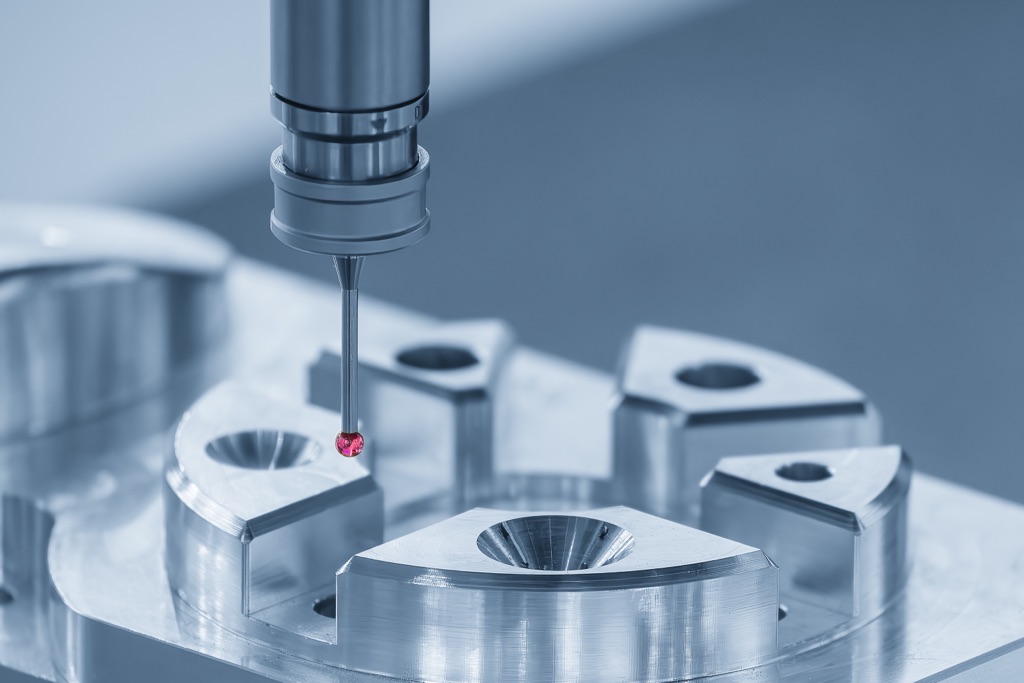
Tactile surface measuring technology works with direct contact to the workpiece. A fine stylus traverses the surface to be tested and captures the smallest height differences. This principle delivers extremely accurate measurement results and is regarded as the reference method in many international standards.
In the stylus scan, a diamond tip with defined geometry moves across the component. The vertical deflections of the stylus are recorded electronically and converted into roughness characteristic values. The stylus scanning method achieves a resolution in the nanometre range and is excellently suited to high-precision surface analyses.
Manual auxiliary devices considerably ease everyday work here. They enable rapid positioning of the workpieces without elaborate alignment. Complex measuring tasks can thereby be carried out more easily and with fewer errors.
Coordinate measuring machines, CMM for short, expand the possibilities of tactile measuring technology. These systems scan components three-dimensionally and capture form, position and contour in a single measuring operation. 3D coordinate measurement with CMM is particularly versatile and is used in almost all industrial sectors.
Tactile contour measurement with modern CMM systems offers impressive accuracies. Numerous measuring points are captured and combined into a complete geometry model. In this way, even complex free-form surfaces can be checked reliably.
Automatic measuring stations additionally increase efficiency. They carry out measuring sequences without staff involvement and eliminate operator influence on the measurement results. Automation and high-precision measuring technology work together perfectly across the entire measuring loop.
Tactile contour measurement does, however, also have its limits. With very soft or sensitive surfaces, mechanical contact can be problematic. With very small or delicate structures, too, the method reaches its physical limits.
Non-contact capture at the speed of light
Optical measuring technology revolutionises quality testing through non-contact measuring methods. Instead of mechanical contact, these systems work with light – whether through lasers, structured illumination or focused beams. This technology opens up entirely new possibilities in surface analysis.
Optical surface measuring technology delivers quantitative, traceable characteristic values – quickly, robustly and precisely. The measurements are often taken in fractions of a second and capture large areas over the full surface. This makes them considerably faster than many tactile methods.
Various optical principles are available. Laser triangulation, fringe projection, focus variation and confocal microscopy each offer specific advantages. The selection depends on the measuring task and the required properties.
Particularly sensitive surfaces benefit from non-contact measurement. Soft materials, painted surfaces or delicate structures can be tested without risk of damage. Hard-to-reach areas or internal geometries can also often be captured better.
Mobile solutions bring the measuring instrument directly to the workpiece. When the size of the component prevents transport to the measuring device, the measurement is taken directly at the place of production. This saves time and enables quality control close to production.
Optical measuring technology shows its strengths particularly in area capture. While tactile methods measure point by point or line by line, optical systems capture entire areas simultaneously. Millions of measuring points are created in the shortest possible time and deliver a complete picture of the surface topography.
Both groups of methods have their justification in modern measuring technology. Tactile surface measuring technology and optical methods are often used in combination. This creates a complete and reliable picture of workpiece quality that meets the highest requirements.
Standards, characteristic values and measurement accuracy in surface testing
Without uniform standards, measurement results would be barely comparable – which is why standards form the backbone of modern surface measuring technology. They create a common language between manufacturers, suppliers and testing laboratories. Only through normative specifications can quality agreements be formulated and verified unambiguously.
Characteristic values make surface properties objectively measurable. The reproducibility of the results depends on standardised measuring methods and minimised measurement uncertainties. Modern measuring technology delivers quantitative, traceable characteristic values that meet the highest requirements.
International standards as the basis for surface characterisation
The standard ISO 4287 defines classical profile-based roughness characteristic values that are obtained from two-dimensional measurements. It has become established worldwide and has formed the basis for technical specifications for decades. Parameters such as Ra, Rz or Rq are calculated from the measured profile according to precisely defined algorithms.
ISO 25178 extends this consideration to three-dimensional surface parameters. Modern optical measuring technology captures entire areas with millions of measuring points instead of individual line profiles. This series of standards takes account of technological progress and enables a more comprehensive characterisation of the topography.
Both standards complement each other ideally in practice. While ISO 4287 continues to be used for many established quality agreements, ISO 25178 offers extended possibilities for complex applications. The comparability between different measuring devices and manufacturers is enabled by these international standards under comparable measuring and evaluation conditions.
Decisive parameters in roughness measurement
The arithmetic mean roughness value Ra is among the most widely used characteristic values of all. It describes the mean deviation of the profile from the centre line and gives a good overall impression of surface quality. Its wide distribution makes it the standard parameter in many sectors.
The mean roughness depth Rz describes the averaged height of the individual roughness depths and takes pronounced peaks and valleys into account more strongly than Ra. This value responds more sensitively to individual outliers than Ra. For sealing surfaces or tribological applications, Rz often delivers more meaningful information than the mean roughness value.
Further important characteristic values in roughness measurement are:
- Rq (root mean square roughness value): Takes larger deviations more strongly into account than Ra through squaring
- RSm (mean groove width): Describes the horizontal distance between profile elements
- Rmax (maximum roughness depth): Captures the largest individual value within the measuring section
- Rsk (skewness): Provides information about the symmetry of the height distribution
The choice of the right parameter depends on the specific application. Friction surfaces require characteristic values different from those for optical components. Roughness measurement thereby delivers valuable indications about manufacturing methods and tool condition.
Strategies for minimising measurement uncertainties
Every measurement is subject to a certain uncertainty – the art lies in quantifying and minimising it. Temperature influences are among the most frequent sources of error in precision metrology. Modern measuring rooms therefore work with a constantly controlled room temperature.
Automatic measuring stations enable the highest reproducibility through autonomous measurement without any operator influence. The human factor as a source of uncertainty is thereby largely eliminated. Validated measuring strategies ensure consistent conditions for every measurement.
Regular calibration against traceable standards forms the basis for reliable results. In this process, the measuring device is matched against certified reference standards. This traceability to national or international standards guarantees comparability across locations and time periods.
Automation and high-precision measuring technology interlock across the entire measuring loop. From sample handling through measurement data acquisition to evaluation, the components work together perfectly. Reliable measurement under high metrological demands thus becomes the standard in modern quality assurance.
Tactile and optical measuring techniques complement each other optimally. They enable a reliable capture of geometric features on the most diverse components. Modern measuring systems achieve the highest reproducibility through autonomous measurement without operator influence. This property makes them indispensable tools in production control.
International standards such as ISO 4287 and ISO 25178 create comparability across national borders. They define uniform characteristic values for roughness measurement and surface testing. Recurring measuring sequences can thereby be designed efficiently, simply and safely.
The continuous further development of measuring technology opens up new possibilities for more precise quality testing. Minimised measurement uncertainty and automated processes increase cost-effectiveness. Companies benefit from better products and optimised manufacturing processes that sustainably strengthen their competitiveness.