How can annual losses caused by metal damage be avoided?
This article provides an easy-to-understand explanation of the most important corrosion testing methods and shows how different procedures are used in the laboratory and in practice.
Every year, industrialised nations lose 3 to 4 percent of their gross domestic product to corrosion damage. The greater part of this damage would be avoidable if existing knowledge were applied correctly.
Whether bridges, vehicles or offshore installations – metallic materials are in use everywhere. Materials testing helps to detect damage at an early stage and to prevent costly failures.
- According to DIN EN ISO 8044:2025, corrosion describes the chemical or electrochemical interaction between a material, usually a metal, and its environment
- Each year, corrosion damage amounting to 3-4% of the gross domestic product arises in industrialised nations
- There are two fundamental types of testing: testing under real conditions and accelerated laboratory testing
- Many cases of corrosion damage can be avoided through targeted testing and prevention
- Both testing approaches – laboratory and real conditions – complement each other for optimal results
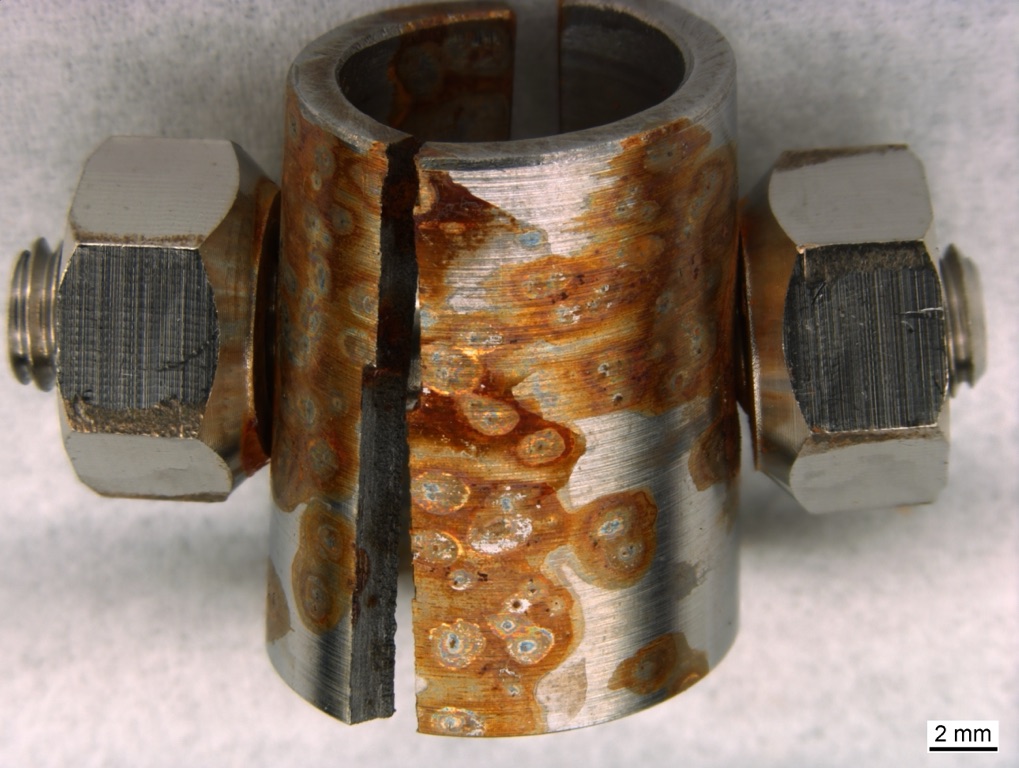
Understanding the fundamentals of corrosion testing
In order to predict material damage, the basic principles of metal degradation must be known. Testing materials for their resistance provides important insights into corrosion behaviour under different conditions. This knowledge forms the basis for the correct selection of materials in various fields of application.
Chemical reactions and test procedures in detail
Corrosion refers to an electrochemical process in which metals revert to their oxide states. The best-known example is the formation of rust in iron or steel. This metal degradation does not occur at random but follows chemical laws.
So-called atmospheric corrosion develops in a wafer-thin film of moisture on the metal surface. This film often remains invisible to the naked eye. Despite its slight thickness, it is sufficient to set the destructive reactions in motion.
In corrosion tests, the speed at which these reactions take place is investigated. Three essential environmental forces drive the corrosion process of atmospheric corrosion:
- Water in the form of air humidity, precipitation or dew
- Oxygen from the surrounding atmosphere
- Ionic compounds, especially chlorides and sulfides
These three components act together and significantly accelerate material degradation. In corrosion investigations, these conditions can be simulated, or the material behaviour is observed under real circumstances. This makes it possible to make reliable statements about the service life of components.
Natural weathering and laboratory tests in comparison
In principle, there are two different approaches to assessing the resistance of materials to atmospheric corrosion. These methods complement each other and each provide specific information.
Outdoor exposure subjects samples to real weather conditions over longer periods. This method is considered an excellent way to verify corrosion resistance under natural weathering influences. However, this approach requires patience, since realistic results only become available after months or even years.
Accelerated laboratory tests take a different path. They make it possible to accelerate corrosion processes in a controlled environment. Aggressive conditions such as high air humidity, intense salt loading and extreme temperature changes take place within a short time.
The advantages of both procedures become apparent in different situations:
- Outdoor exposure provides the most realistic data for long-term forecasts
- Laboratory tests enable rapid results for product development and quality control, above all for comparative materials tests
- The combination of both approaches yields a complete picture of corrosion behaviour
Modern testing laboratories use both strategies in parallel. While accelerated tests provide initial indications of weak points, long-term observations under natural conditions confirm the laboratory results. This dual safeguard creates confidence in the selection of materials.
The decision between natural and accelerated ageing depends on the time frame and the available resources. Development departments prefer rapid laboratory tests. Certification bodies, on the other hand, often require long-term data from outdoor exposure.
Why materials testing for corrosion resistance is indispensable
Systematically testing materials for corrosion resistance saves companies considerable costs and prevents dangerous cases of damage. The investment in precise test procedures pays off several times over. It protects not only financial resources but also a company’s reputation.
Preventive materials testing allows manufacturers to detect weak points at an early stage. This makes it possible to optimise production processes and reduce warranty claims. The correct selection of materials makes the decisive difference between durable products and costly failures.
Economic consequences of corrosion damage
In industrialised nations, 3 to 4 percent of the gross domestic product is lost to corrosion damage every year. These enormous sums correspond to billions of euros that burden economies. The majority of these losses could be avoided through the proper application of existing knowledge.
Companies benefit in several respects from targeted corrosion testing. The advantages of systematic tests become concrete:
- Longer product service life: In the case of automotive paints, improved test procedures led to an extension of durability by more than 100 percent
- Reduced material costs: The correct selection of materials based on tests can yield up to 10 percent cost savings without causing any loss of performance
- Avoidance of costly failures: Complaints and warranty claims considerably damage profits and a company’s reputation
- Competitive advantages: Verified corrosion resistance enables access to new markets and demanding customers
[/su_note]
An investment in testing during the development phase costs a fraction of later damage remediation. Those who test materials in advance avoid expensive recall campaigns. Especially in the case of durable products such as machines, vehicles or building components, this approach clearly pays off.
Corrosion tests also help to meet customer specifications precisely. They make it possible to objectively verify suppliers’ statements. Companies can specifically expand existing product lines and adapt to legal requirements.
Safety-related reasons for regular testing
Corrosion damage can not only become expensive but also life-threatening. Load-bearing components in bridges, aircraft or rail vehicles lose their structural integrity due to corrosion. The consequences range from operational interruptions to catastrophic cases of failure.
Regular tests and inspections are required by law in safety-critical areas. These regulations protect not only assets but also human lives. Tests make it possible to identify critical weak points at an early stage, before a component fails.
In certain fields of application there is no room for compromise:
- Transport sector: Aircraft structures, ship hulls and railway components are subject to strict test cycles
- Infrastructure: Bridges, tunnels and pipelines require continuous monitoring of their corrosion resistance
- Medical technology: Implants and surgical instruments must meet the highest resistance standards
- Energy sector: Power plants and wind turbines require reliable materials under extreme conditions
Systematic corrosion testing forms the basis for safe designs. It gives engineers and decision-makers the necessary data for well-founded material selection. Without this information, many modern technologies and infrastructures would not be feasible.
The combination of economic and safety-related factors makes corrosion testing indispensable. Companies that invest in precise test procedures secure their future viability. They minimise risks while at the same time maximising the quality of their products.
Salt spray test and other classic test procedures
Various classic test procedures make it possible to investigate the corrosion behaviour of materials under controlled conditions. These proven methods have established themselves over decades in industry. They deliver reliable results and are internationally standardised.
Each procedure simulates different environmental conditions. The selection depends on the loads to which a material will later be exposed. This makes it possible to make precise predictions about service life.
How the salt spray test works in detail
The salt spray test is one of the most frequently used methods of corrosion testing. In a special test chamber, the samples are exposed to a fine mist of salt water. This salt mist simulates aggressive environments such as coastal regions or wintry road conditions with road salt.
The test conditions are clearly defined. The temperature in the chamber typically lies between 35 and 50 degrees Celsius. A diluted sodium chloride solution (NaCl) is usually used as the salt solution.
There are two main variants of the salt spray test. The neutral salt spray test uses a pH-neutral solution. The acidified variant accelerates the reactions and delivers faster results.
Internationally recognised standards govern the procedure. The most important standards are ASTM B117 and DIN EN ISO 9227. These standards ensure comparable results in different laboratories worldwide.
After defined periods, the samples are removed and examined. Experts assess the intensity of corrosion, the distribution of rust traces and the condition of coatings. The salt spray test is easy to carry out and ideal for quality control in series production.
Immersion procedures for long-term observations
In the immersion procedure, samples are completely immersed in corrosive liquids. This method is particularly suitable for components that are permanently in contact with liquids during their later use. Typical applications are ship hulls, offshore structures or components in the chemical industry.
There are two fundamental variants. In the continuous immersion test, the samples remain permanently in the corrosive solution. The alternating immersion test according to DIN EN 3212 combines immersion and drying phases.
This alternating load comes very close to real conditions. Ship hulls, for example, are exposed to constantly changing water levels. Long-term observation over weeks or months provides valuable insights into the material behaviour.
Cyclic climate tests to simulate real conditions
Cyclic climate tests are among the most modern forms of climate testing. These cyclic procedures combine various loading phases in a single test. The samples pass through salt spraying, drying, high air humidity and temperature changes.
This reproduces realistic weather conditions. The change between rain, sun and night is reproduced in the laboratory. The transition from day to night with its temperature fluctuations is also taken into account.
An early cyclic test is the Prohesion test. It alternates between salt mist spraying and drying phases. This climate test has proven to be particularly close to practice.
Scientific investigations confirm the superiority of this method. The test results of the cyclic tests show great similarity to outdoor tests with regard to structure, morphology and relative corrosion rates. The standard DIN EN ISO 11997-1 describes the determination of resistance under cyclic corrosion conditions.
Many testing laboratories today rely on these cyclic climate tests. They deliver significantly better correlations with real outdoor conditions than simple continuous tests. For manufacturers this means: the results are more reliable and product development becomes more efficient.
Modern approaches to climate testing and laboratory analysis
Advanced materials testing uses modern technologies for more precise results. Laboratory analysis has developed considerably through innovative measuring instruments and intelligent test chambers. Today, methods are available that are both faster and more meaningful than classic procedures.
These new technologies make it possible to investigate corrosion processes on different levels. From electrical properties at the surface to chemical reactions in the nanometre range – each method provides valuable insights. Together they yield a complete picture of the material behaviour.
Electrochemical measuring methods for real-time analyses
Electrochemical procedures measure electrical properties directly during corrosion. These measuring methods work non-destructively and provide information in real time. This makes it possible to precisely determine reaction rates and protective mechanisms.
Potential measurements show how reactive a material is under certain conditions. Electrochemical impedance spectroscopy (EIS) analyses how effectively coatings protect against corrosion. It detects weak points before visible damage occurs.
Further important techniques include:
- Measurement of galvanic currents between different materials
- Current density-potential curves to evaluate corrosion resistance
- Electrochemical noise (ECN) for continuous monitoring
- Scanning Kelvin probe (SKP) for local potential distribution
These methods are particularly valuable in corrosion testing because they detect problems at an early stage. Engineers can optimise protection concepts before costly damage occurs.
Microscopic and spectroscopic investigations
Electron microscopy procedures make even the smallest defects visible. Scanning electron microscopy (SEM) shows surface changes down to the nanometre range. This makes it possible to recognise exactly where and how corrosion begins.
Transmission electron microscopy (TEM) enables insights into the inner structure of materials. Combined with energy-dispersive X-ray analysis (EDX), the elemental composition can be determined. The focused ion beam (FIB) specifically prepares samples for detailed investigations.
Spectroscopic procedures identify chemical reaction products with high accuracy:
- X-ray photoelectron spectroscopy (XPS) for near-surface areas
- Auger electron spectroscopy for element distribution
- Time-of-flight secondary ion mass spectrometry (ToF-SIMS) for molecular information
These laboratory analysis techniques help in the development of improved protection systems. They show exactly which corrosion products arise and which elements are involved.
Accelerated tests with precise control
Modern test chambers have revolutionised corrosion testing. Automotive manufacturers have driven this development to a significant degree. The latest systems regulate air humidity, temperature and salt loading with high precision.
Instead of weeks of continuous spraying, samples are today sprayed in a targeted manner. This method shortens the test time considerably and delivers more realistic results. The change between moist and dry phases is reproduced exactly.
Particularly important is the precise control of relative air humidity. Outdoor materials are most of the time in medium humidity ranges. Modern test procedures capture precisely this range, including the transition phases. As a result, they simulate real conditions much better than older methods.
These accelerated test procedures make it possible to qualify paint finishes and protective coatings in days instead of months. The combination of precise control and realistic conditions makes them an indispensable tool in modern corrosion testing.
Practical application and assessment of corrosion behaviour
A successful corrosion test begins long before the first sample enters the test chamber. The practical execution requires clear objectives and a well-thought-out test programme. Different test categories pursue different purposes and must be planned accordingly.
Most corrosion tests serve the purpose of quality control. These short, defined screening tests run over fixed time intervals. They deliver clear results according to the pass-or-fail principle.
Further test categories include qualification and validation of medium-length duration. Correlative tests rank the corrosion behaviour of different materials. Predictive tests determine service life and acceleration factors but require longer testing times.
Modern testing technologies deliver precise results in a shorter time. The combination of various procedures yields the most complete picture of corrosion resistance. Accelerated tests in the laboratory optimally supplement realistic outdoor exposure trials.
The advantages reach far beyond mere damage prevention. Improved product durability, savings in material costs and increased safety pay off in the long term. Companies meet customer specifications more reliably and strengthen their market presence.
Corrosion testing enables the opening up of new markets and provides competitive advantages. Suppliers’ statements can be objectively verified. Existing product lines can be expanded in a targeted manner.
The existing expertise in materials testing is waiting to be put into practice. Those who select the right test procedures and carry them out in compliance with standards gain valuable insights for development and quality assurance. The investment in professional corrosion testing secures the longevity and reliability of technical products.