How can you make sure that welded joints in machines or structures will really hold?
This question arises every day in many areas of industry. In this article you will learn which test methods are used to inspect weld seams and how they contribute to quality assurance.
Welded joints are often the critical points of a structure. Their quality directly determines stability and safety. Systematic testing makes it possible to detect hidden defects such as cracks or cavities at an early stage.
- Weld seam tests assess the quality of welded joints and ensure safety in structures
- Two main categories exist: non-destructive and destructive test methods with different fields of application
- Defective weld seams can lead to failures – systematic inspections prevent costly damage
- Tests are based on established norms and standards to comply with quality criteria
- Welded joints must be free from cracks, voids and other defects
- Modern testing techniques enable early defect detection before commissioning
Fundamentals of weld seam testing
Welded joints bond materials permanently – but only thorough inspection ensures their quality. Wherever welded joints are used, weld seam quality is a core element of quality assurance. Systematic inspection detects possible defects before they become safety risks.
During welding, heat input creates permanent joints between components. However, this process can lead to undesirable changes in the material properties. That is why every welded structure requires careful inspection of the resulting joints.
Systematic inspection of welded joints
Weld seam testing examines both the external geometry and the internal structure of welded joints. The method determines whether a weld seam meets the defined quality criteria. Critical defects are reliably detected in the process.
The inspection covers various aspects of the joint. Surface features such as cracks, pores or uneven seam shapes can be detected by visual methods. Hidden defects inside the weld seam, on the other hand, require special techniques of non-destructive materials testing.
Different materials react differently to the welding process. Steel, aluminium, copper and plastic each place their own demands on the test. The heat input affects the material properties around the weld and can cause stresses there.
The goal of all test methods is to identify defects that impair the strength or service life of the joint. Regular inspections ensure consistent compliance with norms and safety standards. The test thus protects not only the component itself, but also people and the environment.
Fields of use and areas of application
Weld seam tests are indispensable in numerous industries. Wherever welded joints are exposed to high mechanical loads, inspection is used. The range extends from the construction industry to medical technology.
In the construction industry, tests ensure the stability of steel structures. Bridges, high-rise buildings and industrial halls rely on flawless weld seams. A single defect could have serious consequences here.
The automotive industry inspects body and chassis components for the highest quality. Every welded joint must withstand crash loads and survive years of vibration. Modern vehicles contain hundreds of tested weld points.
Tests in aviation are particularly critical. Safety-relevant components undergo strict inspection procedures before they are put into use. There is no room for compromise here when it comes to weld seam quality.
In the energy sector, pressure vessels and pipelines are subject to extreme conditions. High pressures, temperatures and aggressive media demand flawless joints. Regular inspection prevents leaks and dangerous failures.
Medical technology also relies on precisely tested welded joints. Implants and medical devices must meet the highest quality standards. Here it is a matter of human lives.
Welding defects can considerably reduce load-bearing capacity. In the worst case, they lead to material failure with serious consequential damage. That is why thorough testing is an investment in safety and longevity.
Normative principles and assessment systems
DIN EN ISO 5817 is the central norm for the assessment of weld seams. It applies to joints made of steel, titanium, nickel and their alloys. This norm defines clear criteria for acceptable quality.
The quality level system is divided into three stages. Level B stands for high requirements, level C for medium and level D for low requirements. Depending on the quality level, different tolerances for irregularities are permissible.
Specific requirements are placed on each weld seam. These depend on the expected strength, the visual appearance and other criteria. The requirements depend directly on the later function of the component.
On the basis of the specifications, each weld seam is assigned to a quality level. The assignment already takes place in the planning phase. Designers determine which quality level is necessary at which point.
If the permissible tolerances are exceeded, a weld seam defect is present. The norm specifies precise limit values for various types of defects. Inspectors can thus objectively assess whether a seam meets the requirements.
For aluminium joints, DIN EN ISO 10042 applies. Aluminium behaves differently from steel during welding and requires adapted assessment criteria. Here, too, graded quality levels exist.
A component often has weld seams of different quality levels. Highly loaded areas require stricter testing than less critical points. This grading enables economical manufacturing while ensuring safety.
The norms create clarity for everyone involved. Welders, inspectors and clients work with the same standards. This makes quality measurable and comparable.
Test results can be clearly interpreted on the basis of the norms. Documented assessments prove compliance with the specifications. These records are often legally required and serve as proof of quality over many years.
Quality characteristics of welded joints
Quality characteristics determine whether a welded joint meets the requirements and functions reliably over the long term. Weld seam quality is influenced by various factors that can occur both on the surface and inside the joint. Experts fundamentally distinguish between surface defects and internal defect types, each of which requires different test methods.
A careful assessment of these characteristics is decisive for the safety and durability of any welded structure. Both defect types can considerably impair load-bearing capacity and must therefore be detected at an early stage.
Detecting and assessing surface defects
Surface defects are irregularities that are visible on the outside of the weld seam or open towards the surface. These types of defects can often be identified during a visual inspection or with simple aids. The most common and most critical of all surface defects is cracking.
Cracks can occur in various forms. Longitudinal cracks run parallel to the weld seam, while transverse cracks are oriented perpendicular to it. Incipient cracks typically form at the transitions between the weld seam and the base material, where stress concentrations are particularly high.
Other important surface defects include:
- Visible pores: Small cavities that appear on the seam surface
- Undercuts: Notches that are too deep at the edge of the weld seam
- Edge misalignment: Unequal height of the components to be welded
- Excessive seam reinforcement: Too much or too little applied material
- Spatter and start points: Undesirable material deposits
These surface irregularities not only impair the aesthetics of the welded joint. They can also act as predetermined breaking points where cracks form or spread further under load. Sharp notches are particularly critical, as they concentrate stresses and lastingly jeopardise weld seam quality.
Understanding internal defect types
Volume defects are hidden inside the weld seam and cannot be detected without special test methods. These internal defect types pose a particular challenge, as they often only become visible upon close examination. Pore formation is one of the most common problems in welding work.
In pore formation, small gas bubbles or cavities form in the weld metal. These pores form when gases are trapped in the material during the solidification process. They can occur individually or group into pore nests, which reduces the effective cross-sectional area and decreases strength.
Lack of fusion refers to areas without complete fusion between the weld metal and the base material. This type of defect is also referred to as “lack of fusion”. Such inadequately bonded areas act like internal cracks and considerably reduce the load-bearing capacity of the joint.
Slag inclusions are foreign particles that remain in the weld metal as residues of electrodes or protective fluxes. These solid inclusions interrupt the homogeneous structure of the weld seam. Insufficient penetration is also among the critical volume defects – here the seam does not capture the entire wall thickness of the component.
The most important internal defect types at a glance:
- Pores (gas inclusions): Reduce the load-bearing cross-section
- Lack of fusion: Inadequate fusion of the materials
- Slag inclusions: Foreign particles in the weld metal
- Insufficient penetration: Seam does not reach full depth
Effects of welding defects
Welding defects can have serious consequences for the entire structure. A failure of the welded joint can sometimes lead to considerable damage to structures, machines or vehicles. The consequences range from economic losses to dangers to human life.
Cracking poses the greatest risk. Under cyclic loading, cracks can spread steadily – a process known as fatigue cracking. This insidious damage mechanism can ultimately lead to the sudden fracture of the entire joint, often without prior warning signs.
Pores and lack of fusion considerably reduce the mechanical strength. They reduce the load-bearing cross-section and create weak points that can give way under load. The stiffness of the joint decreases, which leads to undesirable deformations.
The heat input during welding causes additional problems. The heat-affected zone next to the weld seam can change its properties. The material can harden or become brittle, which reduces toughness. Corrosion resistance also frequently suffers from the thermal influences of the welding process.
In safety-critical applications, even small defects are unacceptable:
- Aviation: Highest requirements for weld seam quality
- Power plant construction: Extreme operating conditions demand flawless seams
- Pressure vessels: Failure can lead to explosions
- Bridge construction: Long-term safety for many people
Thorough weld seam tests therefore not only meet regulatory requirements. They protect lives, prevent costly damage and ensure the reliability of technical installations. The investment in professional test methods pays off through higher safety and a longer service life of the structures.
Ultrasonic testing and radiographic testing
Internal defects remain hidden from the naked eye – here specialised test methods are used that penetrate deep into the material. These two methods are among the most important tools of non-destructive materials testing. They complement each other perfectly and reliably reveal different types of defects.
How sound waves track down defects
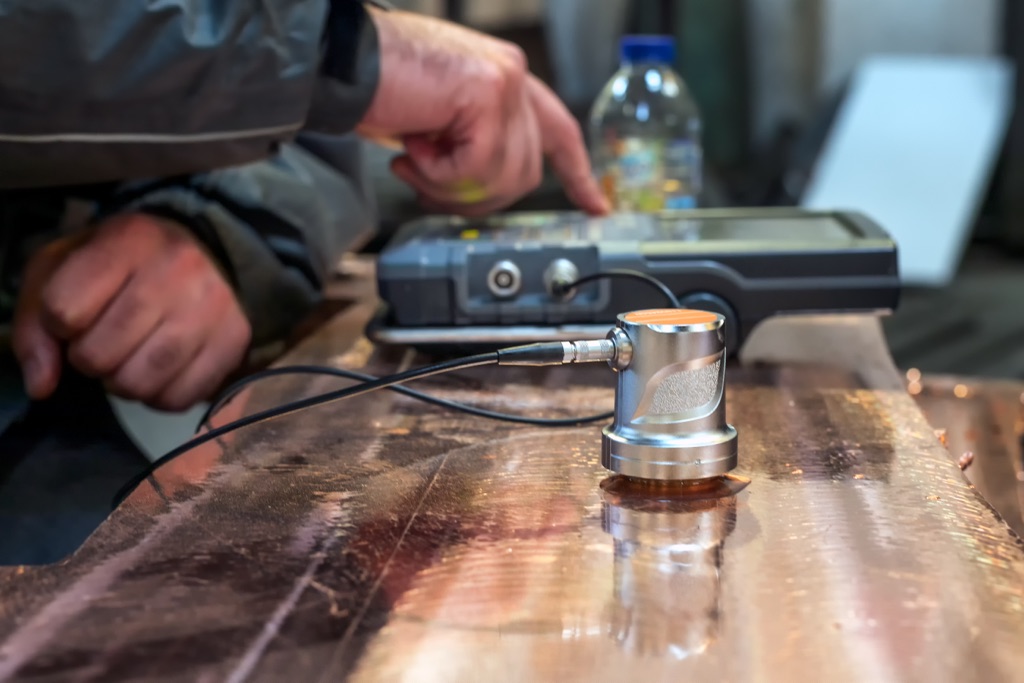
Ultrasonic testing works with high-frequency sound waves that are inaudible to humans. A special test instrument sends these waves through a probe directly into the material. The waves spread evenly as long as the material is homogeneous.
As soon as the sound waves hit an irregularity, something interesting happens. They are reflected at this point and return as an echo. The test instrument captures this echo and evaluates it.
The depth of the defect can be calculated from the transit time of the signal. The strength of the echo reveals something about the size and type of the defect. In this way, inspectors can precisely locate pores, cracks or lack of fusion.
There are various techniques for ultrasonic testing:
- Pulse-echo method: Measures the echoes reflected back from defects
- Through-transmission method: Assesses the attenuation of the signal as it passes through the material
- Normal-beam testing: Uses straight sound waves for simple geometries
- Angle-beam testing: Works with obliquely beamed waves for weld seams
Angle-beam testing is particularly well suited to welded joints. The waves penetrate the seam at an angle and reliably detect planar defects as well. Lack of fusion running parallel to the seam surface thus becomes more visible.
The advantages of ultrasonic testing are obvious. The method is fast, mobile and cost-efficient. Mobile devices enable tests directly on site – even on large structures such as pipelines or steel bridges.
The method reacts very sensitively to many types of defects, especially to planar flaws – however, detectability depends on the defect orientation and the test parameters. Even tiny irregularities in the material generate measurable echoes. However, trained personnel are needed for the correct interpretation of the signals.
Rough surfaces can make testing more difficult. The sound waves can then not be optimally coupled into the material. Complex geometries also sometimes pose a challenge.
Looking inside with radiation
Radiographic testing uses a completely different physical approach. Here X-rays or gamma rays are used that penetrate the material. On the other side, the transmitted radiation is captured by a film or digital detector.
The resulting image shows the internal structure of the weld seam like a kind of X-ray. Volume defects with lower density let more radiation through and appear darker; dense inclusions, on the other hand, can cause brighter indications.
X-ray testing offers a particular advantage: it creates permanent documentation. These images can be archived and assessed by several experts if required. Years later, they can be evaluated again.
Volume defects such as pores, slag inclusions or insufficient penetration are clearly recognisable. The method makes these irregularities clearly visible. However, planar defects such as thin cracks have a disadvantage.
If they are unfavourably oriented to the direction of the radiation, they may remain undetected. Radiographic testing also requires access to both sides of the weld seam. This is not always possible.
The method also brings challenges:
- The time required for setup and exposure is higher
- Costs for radiation sources and protective measures
- Strict safety regulations when handling ionising radiation
- Shielded areas or special test times necessary
Despite these limitations, X-ray testing remains indispensable in critical areas. In pressure vessel construction, petrochemistry and aerospace it is standard. The reliable and well-documented quality control justifies the effort.
Both methods complement each other ideally in practice. Ultrasound scores with speed and flexibility. Radiographic testing, on the other hand, delivers vivid images that can be used over the long term.
Magnetic particle testing and eddy current testing
Some test methods work with the natural properties of the materials to make defects visible. They use physical phenomena such as magnetism or electric currents. These methods are particularly effective for certain types of material.
The two methods complement each other excellently. While one method only works on steel and iron, the other covers a broader spectrum of metals. Both focus mainly on surface defects and near-surface areas.
They provide fast results and are relatively easy to apply. This makes them popular tools in industrial quality control. Each method has its specific strengths and fields of application.
Other test methods and combination options
Not every weld seam test requires elaborate technology – sometimes proven basic methods are sufficient for an initial sound assessment. In addition to the complex methods, non-destructive materials testing also includes simpler methods that deliver results quickly and cost-effectively. Especially for beginners, it is important to understand that different test methods have different strengths and can complement each other ideally.
In practice, individual methods are rarely used in isolation. Rather, experienced inspectors combine several methods to obtain a complete picture of the weld seam quality.
The eye inspects too: visual inspection as the first step
Visual inspection forms the basis of every weld seam inspection. An experienced inspector already recognises many quality characteristics and potential weak points with the naked eye. This method is fast, cost-efficient and requires no elaborate equipment.
During visual inspection, the specialist examines the weld seam systematically. Are the seam transitions even? Do cracks, pores or spatter appear on the surface? Does the seam geometry look harmonious, or do irregularities catch the eye?
For precise measurements, special weld seam gauges are used. These mechanical measuring tools enable the exact determination of important parameters. The throat thickness of a fillet weld, the seam width or the reinforcement can be reliably recorded with them.
Modern aids considerably extend the possibilities of visual inspection. Magnifiers enlarge details, endoscopes reach hard-to-access spots, and mirrors enable views into hidden areas. For initial quality checks during production, this method is indispensable.
The limits, however, are clearly obvious. Visual inspection captures only surface defects. What lies hidden inside the weld seam remains invisible. In addition, the reliability depends heavily on the experience and attentiveness of the inspector.
Despite these limitations, visual inspection is prescribed as a mandatory test in almost all relevant norms. It forms the first step before more elaborate methods of non-destructive materials testing are used.
Making the finest cracks visible: penetrant testing
Penetrant testing tracks down even the finest hairline cracks that the human eye would overlook. This method uses the capillary action of special liquids to make surface defects visible. For materials that are not magnetic, this method represents a valuable alternative.
The test process follows a clear scheme in several steps. First, the weld seam is thoroughly cleaned and degreased. Only in this way can the pores and cracks really be open and accessible.
Then the inspector applies a liquid penetrant – usually a bright red or fluorescent liquid. This has an extremely low surface tension and creeps through capillary forces even into microscopically small cracks. After a dwell time of a few minutes, the excess penetrant is carefully removed from the surface.
In the next step, the developer comes into play. This white, absorbent powder or suspension draws the penetrant remaining in the defects back to the surface. There, high-contrast indications form: red or fluorescent lines mark exactly the position and shape of the cracks.
The great advantage of this method lies in its material independence. It works on all non-porous materials – metals, ceramics, glass and certain plastics. Aluminium, stainless steel or titanium can be tested excellently with it, even if they are not ferromagnetic.
Penetrant testing achieves an impressive sensitivity. Cracks in the micrometre range are reliably detected. However, the method is time-consuming, as several process steps must be carefully completed.
One important limitation that beginners should know: only open surface defects are captured. Defects lying just below the surface or internal volume defects remain invisible. In aviation and power plant construction, this method is nevertheless part of the standard.
Intelligent combination for maximum safety
Every test method has its specific strengths and weaknesses. Visual inspection is fast, but superficial. Penetrant testing finds the finest cracks, but no internal defects. A well-thought-out combination of different methods provides the best overall conclusiveness.
In practice, modern test strategies follow a multi-stage concept. First, a visual pre-inspection always takes place in order to rule out gross defects. This step is quickly completed and prevents unnecessary effort with obviously deficient weld seams.
Then, depending on the material and requirements, specialised methods of non-destructive materials testing are used. For safety-critical applications, inspectors frequently combine ultrasonic and radiographic testing. These reliably reveal internal volume defects.
In addition, surface tests are added. Magnetic particle testing on ferromagnetic materials or penetrant testing on non-magnetic materials round off the test programme. This creates a complete picture from the outside and inside.
Economic aspects play an important role in the selection. Cost-intensive methods such as radiographic testing are deployed specifically where they bring the greatest safety benefit. Less critical seams are tested with faster, more cost-effective methods.
Modern developments continuously change the testing landscape. AI-based image evaluation supports inspectors in defect identification. Inline test systems enable continuous quality monitoring during production. These innovations lead to higher process reliability and less waste.
The intelligent combination of different test methods is the key to maximum weld seam quality. Different types of defects are best detected with different methods. Those who consistently put this insight into practice achieve the highest safety while ensuring economic efficiency.
The selection of the right test method depends on the material, the component geometry and the applicable norms. Magnetic particle testing is suitable for ferromagnetic materials, while ultrasonic testing captures deeper structures. Combined test strategies ensure the best possible defect detection.
The future lies in automation and intelligent systems. AI-based solutions enable complete testing in real time and detect deviations immediately. These technologies increase product quality and significantly reduce waste rates.
Companies that rely on modern testing technologies secure a clear competitive advantage. The consistent application of proven methods according to DIN EN ISO 5817 guarantees traceable results. Regular training of the test personnel remains indispensable for the quality of welded joints.
Mechanical weld seam testing protects against failures and prevents costly consequential damage. It actively contributes to safety, longevity and economic efficiency. Precise tests minimise risks and create trust in product quality.