How can tiny structures be made visible that conventional light microscopes can no longer resolve?
Scanning electron microscopy offers exactly the solution here and opens up fascinating insights into microscopically small worlds. In this article you will learn how the SEM method works, what advantages it offers and where it is used.
You will discover how electron beams instead of light waves enable impressive magnifications. In doing so, you will get to know the special capability of this high-resolution microscopy: the exceptional depth of field, which creates a plastic, three-dimensional impression.
- The SEM uses electron beams for the high-resolution imaging of object surfaces with impressive depth of field
- The technique overcomes the limits of classical light microscopy and achieves significantly higher magnifications
- Manfred von Ardenne invented the method in 1937 and thereby laid the foundation for modern materials analysis
- Areas of application range from materials testing through biological research to semiconductor technology
- The electron beam is systematically scanned across the sample to generate detailed images
- The method provides precise information about surface condition and structural properties
- Both in research laboratories and in industrial quality control, the SEM is indispensable
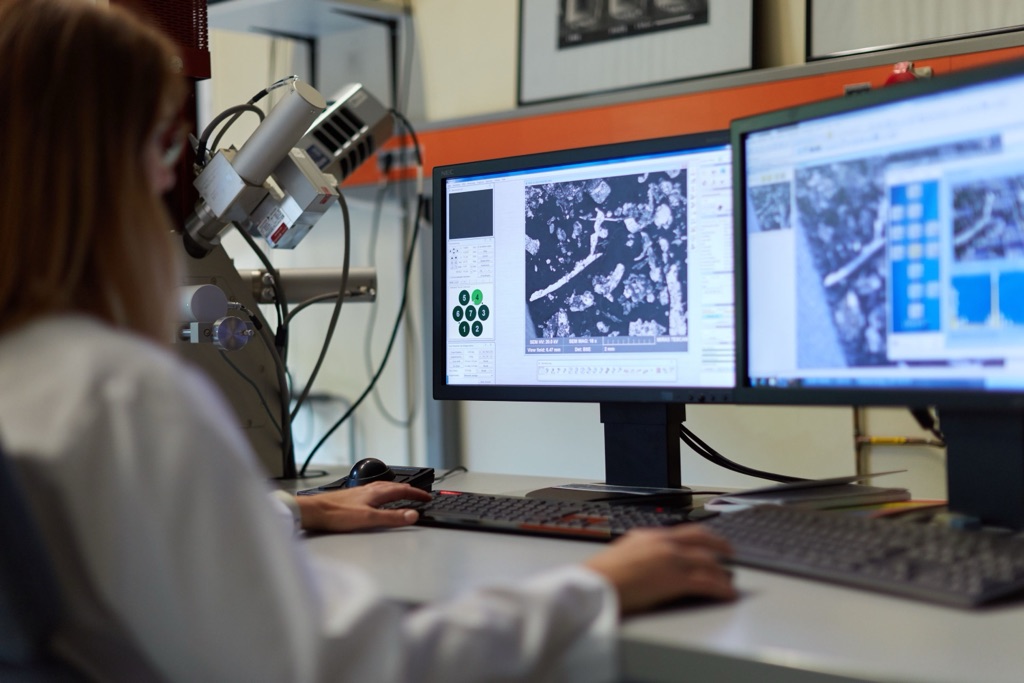
What is scanning electron microscopy?
Scanning electron microscopy enables insights into dimensions that remain hidden from the human eye. This technology uses electron beams instead of light to image surfaces and structures with exceptional detail. Scientists and engineers use this method to examine materials at the nanometre level.
The method is based on the targeted control of electrons that are guided across a sample. In the process, signals are generated that are converted into high-resolution images. The result is quasi-three-dimensional representations with impressive depth of field.
Fundamentals of electron microscopy
The history of electron microscopy began in 1925 with an important discovery by Hans Busch. He found that magnetic fields can function as lenses for electrons. This realisation laid the foundation for a revolutionary development in microscopy.
Ernst Ruska and Max Knoll built the first electron microscope in 1931. Their work marked the beginning of a new era in science. Only six years later, in 1937, Manfred von Ardenne invented the first high-resolution scanning electron microscope.
Von Ardenne’s innovation was groundbreaking. He developed a system with strong magnification and the ability to scan very small areas precisely. His invention made it possible for the first time to examine surface structures in detail at the nanometre range.
The physical principle behind the electron microscopy technique is fascinating. Electrons have a considerably shorter wavelength than visible light. This property is the key to high resolution.
While light waves are several hundred nanometres long, accelerated electrons move in the picometre range (depending on the accelerating voltage). The shorter the wavelength, the smaller the details that can be detected. This physical advantage makes electron microscopy so powerful.
Advantages over light microscopy
Electron microscopy examination offers considerable advantages over conventional light microscopes. The resolving power is typically 1 to 2 nanometres. By comparison: conventional light microscopes achieve 200 nanometres at best.
This difference means that structures become visible that are a thousand times smaller. The maximum magnification reaches into the range of several hundred thousand times, while light microscopes find their limit at 2,000 times. This enormous magnification opens up entirely new possibilities for research.
A particular advantage of electron microscopy in the nanometre range is the exceptional depth of field. Light-microscopy images usually show only a thin plane of focus. Areas above or below appear blurred.
In contrast, surfaces appear completely sharp in the scanning electron microscope. From raised structures to deep recesses, everything remains clearly recognisable. This property enables quasi-three-dimensional representations with a plastic effect.
The spatial perception of the sample surface is thereby significantly improved. Scientists can analyse surface topographies precisely. Rough surfaces, fine structures and complex geometries become visible in all their complexity.
Further strengths lie in the versatility of the application possibilities. The technology is suitable for a wide variety of materials – from metals through ceramics to biological samples. Nanoscale electron microscopy has thus established itself as a fundamental tool in research and industry.
In summary, the method combines high resolution, large depth of field and versatile applications. This combination makes it an important instrument for detailed structural analyses in the micro and nano range.
How scanning electron microscopy works
The heart of scanning electron microscopy is a complex interplay of electron generation, beam guidance and signal acquisition. The individual processes mesh seamlessly and enable the creation of high-resolution images. Each step plays an important role in the quality of the later images.
The entire process can be divided into three central phases. First, a fine electron beam is generated and precisely focused. The electrons then interact with the sample and generate various signals. Finally, the systematic scanning creates a detailed image of the surface.
Generation and focusing of the electron beam
The electron source marks the starting point of every microscope image. In simpler devices, a tungsten wire is often used, which releases electrons when heated. Alternatively, manufacturers also use lanthanum hexaboride crystals (LaB₆), which deliver higher beam intensity.
Modern high-performance systems work with field emission cathodes. These components generate electrons through strong electric fields instead of through heat. The advantage lies in the considerably higher image sharpness and longer service life.
After generation, the electrons are accelerated by voltages between 8 and 30 kilovolts. The charged particles reach considerable speeds in the process. Magnetic coils then take over the task of beam shaping.
These electromagnetic lenses function similarly to glass lenses in light refraction. They focus the electron beam into a tiny focal point on the sample surface. The more precise the focusing, the higher the subsequent resolution.
Interaction between electrons and sample
As soon as the electron beam strikes the sample, a variety of physical effects arise. These interactions provide different information about the material being examined. Each signal contributes specific details to the surface structure analysis.
Secondary electrons (SE) are knocked out of the uppermost atomic layers. They are particularly well suited for topographic imaging, as they react sensitively to surface changes. Even the finest structures thereby become visible.
Backscattered electrons (BSE) arise when primary electrons are deflected by atomic nuclei. These signals provide information about the material composition of the sample. Heavier elements appear brighter than lighter ones.
Further interactions include the generation of X-rays and cathodoluminescence. Auger electrons can also be released at certain energy levels. These additional signals considerably expand the analytical possibilities.
Scanning method and image build-up
The eponymous scanning method forms the final step towards image generation. The focused electron beam moves systematically across the sample surface. The principle resembles the line interlacing of older tube televisions.
Line by line, the beam scans the area to be examined. At each image point, detectors capture the resulting signals. These are immediately converted into brightness values and displayed on a screen.
The synchronisation between beam movement and screen display takes place in real time. In this way, a complete image of the surface structure gradually emerges. The quality depends on several parameters.
The magnification can be flexibly adjusted and is based on a clever principle. It results from the ratio between the scanned sample area and the constant monitor size. A smaller scanned area automatically leads to higher magnification.
Modern systems enable magnifications from a few hundred to several hundred thousand. This enormous range makes scanning electron microscopy a versatile tool. From overview images to nanostructure analysis, the method covers a broad spectrum.
Design and technical components of an SEM
The performance of an SEM depends on the interplay of its technical components. Each component fulfils a specific task in the overall system. Only through the precise coordination of all elements do high-resolution images emerge.
The microscope combines mechanics, electronics and vacuum technology in a complex design. From the electron source to the detector, all assemblies work synchronously. This integration enables the exceptional image quality of modern devices.
Areas of application of scanning electron microscopy
Whether tracking down material defects, researching cell structures or testing microchips – scanning electron microscopy masters diverse challenges. The spectrum ranges from the automotive industry through medical technology to semiconductor production. Wherever microscopic details are decisive, this technology is used.
The versatility makes the SEM an indispensable tool in research and industry. Every day, quality engineers, scientists and developers rely on the precise images. What exactly can be examined with it?
Use in materials research and in materials testing
In materials research, scanning electron microscopy plays a central role in quality assurance. Metallic components are examined for cracks, pores and inclusions. A broken gearwheel immediately reveals under the electron beam whether material fatigue or a manufacturing defect led to the failure.
Quantitative microstructure analysis enables precise measurements of grain sizes in metals. Engineers thereby determine the phase distribution and characterise precipitates. These data are decisive for assessing mechanical properties.
Fracture surface analyses are among the most frequent applications in materials testing. Brittle fractures usually show characteristic cleavage facets, while ductile fractures often exhibit dimple structures. Fatigue cracks can be identified by typical striations.
Coated components also benefit from SEM analysis. The adhesion between base material and coating is checked. Even thin layer thicknesses (< 1 µm) can be precisely measured in cross section. Inhomogeneities or detachments are made visible.
- Examination of weld seams for lack of fusion and undercut notches
- Analysis of corrosion phenomena on metallic surfaces
- Testing of composite materials for delaminations and fibre distribution
- Identification of foreign inclusions in plastics and elastomers
Use for biological and medical questions
In the life sciences, scanning electron microscopy opens up fascinating insights into the world of microorganisms. Bacteria appear in high detail fidelity with their characteristic surface structures. Viruses, although considerably smaller, can be depicted at high magnification.
Cell membranes and their complex structures become visible with impressive clarity. Researchers use this to study how cells communicate with one another. The interaction between different cell types can be documented visually.
In dentistry, the technology is used in the development of implants. The surface condition of artificial tooth roots decisively influences osseointegration. Manufacturers optimise their products based on SEM images.
Bone structures are analysed in detail in order to better understand diseases such as osteoporosis. The microarchitecture of bone tissue provides information about its stability. The examination of tissue samples after surgical procedures also delivers valuable findings.
- Characterisation of the particle size and shape of active-ingredient powders
- Quality control in tablet manufacturing through surface analysis
- Examination of release mechanisms in sustained-release preparations
- Analysis of inhalation powders for respiratory medications
Benefit in semiconductor technology and in the electronics industry
Semiconductor technology would be barely conceivable without scanning electron microscopy. Modern microchips contain structures in the nanometre range. Every defect, even the tiniest contamination, can lead to failure.
Conductor tracks on integrated circuits are routinely inspected. Short circuits due to material bridges can be reliably identified. Interrupted connections are made visible and analysed.
The continuous miniaturisation of electronic components places extreme demands on quality assurance. Transistors with gate lengths of a few nanometres require high-resolution analysis methods. The SEM reliably meets these requirements.
Solder joints on circuit boards are checked for quality. Cold solder joints, voids or insufficient wetting lead to contact problems. Production failures can be avoided through systematic inspections.
Wear phenomena on contacts and plug connections are documented in detail. Corrosion, material abrasion or deposits impair functionality. Manufacturers develop improved designs based on these findings.
- Failure analysis of failed electronic components
- Process control in semiconductor manufacturing at every production step
- Inspection of bond connections between chip and package
- Identification of particles and contamination in cleanrooms
- Analysis of ageing phenomena during long-term tests
Comparison between SEM and TEM
The choice between different electron-microscopy methods depends heavily on the respective examination task. In addition to the scanning electron microscope, the transmission electron microscope (TEM) provides researchers with another important technology. Both methods use electron beams, but work according to fundamentally different principles and deliver different information about the material being examined.
The differences begin already with the basic measurement approach. While the SEM guides a fine electron beam line by line across the sample surface, the TEM transmits a broad electron beam through the entire sample. These different modes of operation lead to complementary analytical possibilities that ideally complement each other in modern materials research.
How the transmission technique works
The transmission electron microscope works according to a transmission principle. The electron beam penetrates an ultra-thin sample completely. On the opposite side, sensors detect the transmitted electrons and generate an image from them.
This technique enables unique insights into the inner structures of materials. The TEM visualises crystal lattices, atomic arrangements and defects in the material interior. The resolution thereby reaches the atomic range and thus considerably surpasses the possibilities of scanning electron microscopy.
Sample preparation, however, places high demands. The material to be examined must be thinned to thicknesses between 50 and 500 nanometres. Electrons can only pass through such extremely thin layers and deliver usable signals.
This elaborate preparation process mechanically alters the original sample structure. The intensive processing can create artefacts or damage sensitive structures. For many questions, the TEM nevertheless remains the only method to make atomic details visible.
Complementary areas of application of both methods
Each method possesses specific strengths for different analysis objectives. The scanning electron microscope scores with uncomplicated sample preparation and versatile applicability. The sample remains largely intact mechanically and does not have to be thinned.
A particular advantage lies in the great depth of field of SEM images. This property creates plastic, three-dimensional-looking representations of surfaces. Topographic structures, surface defects and material contrasts can be visualised excellently.
The TEM, on the other hand, offers unsurpassed insights into the material interior. Crystal defects, dislocations and phase boundaries become visible with atomic precision. For crystallographic investigations and structure elucidation, this method is indispensable.
- Imaging: SEM shows surface topography, TEM visualises inner structures
- Resolution: TEM achieves atomic resolution, SEM lies in the nanometre range
- Sample preparation: SEM requires only little preparation, TEM requires ultra-thin sections
- Depth of field: SEM delivers high depth of field, TEM shows flat sample areas
- Area of application: SEM for surface analysis, TEM for structure elucidation
The TEM complements this information with detailed structural data from the material interior. Both methods together enable a comprehensive material characterisation from the surface to the atomic level.
The decision for a method is guided by the specific question. For surface examinations and topography analyses, the SEM is the first choice. For questions about the inner structure and atomic arrangement, there is no way around the TEM.
Advanced analysis techniques: EBSD and FIB
Decoding crystal structures and machining materials in the nanometre range – two advanced techniques make it possible. These specialised methods transform the scanning electron microscope into a versatile analytical tool. They deliver information that goes far beyond classical surface images.
Crystallographic analysis with electron backscatter diffraction
Electron backscatter diffraction, EBSD for short, makes the crystallographic orientation of near-surface areas visible. When electrons strike crystalline materials, they are diffracted according to characteristic patterns. These diffraction patterns depend directly on the crystal structure and its spatial orientation.
The resulting Kikuchi lines are captured on a special detector screen. Modern software automatically analyses these patterns for each image point. The result is colour-coded maps that depict the crystallographic orientation.
- Grain sizes and grain shapes can be measured precisely
- Grain boundaries are classified by type and character
- Textures show preferred orientations in the material
- Phase distributions are recorded quantitatively
In metallurgy, EBSD helps optimise mechanical properties such as strength and ductility. Geologists use the technique to reconstruct deformation processes in rocks. The method is central to understanding how microscopic structures influence macroscopic properties.
Precise material machining through focused ion beams
Focused Ion Beam (FIB) technology works with a finely focused beam of gallium ions. These ions strike the sample surface with high energy and remove material in a targeted manner. The precision lies in the nanometre range – a true nano-mill.
With the FIB-SEM, hidden structures can be exposed without mechanically damaging the sample. Layer by layer, material is removed. Inner microstructures, coating systems and interfaces thus become accessible.
- Preparation of cross sections through multilayer systems
- Production of ultra-thin lamellae for transmission electron microscopy
- Exposure of semiconductor structures for failure analysis
- Targeted structuring for microelectronic applications
The ion beam also enables deposition processes. In the process, protective layers are applied or electrical contacts are produced. This versatility makes the technique fundamental to the semiconductor industry and materials research.
Synergy effects through combined systems
Dual-beam microscopes combine electron beam and ion beam in one vacuum chamber. This combination creates unique analytical possibilities. The ion beam processes the sample, while the electron beam continuously delivers images.
A particular advantage lies in 3D tomography. The system removes material in an automated manner and photographs after each cut. From hundreds of such images, a three-dimensional model of the inner structure emerges.
These SEM-FIB systems enable:
- Spatial acquisition of pores and cracks in materials
- Three-dimensional mapping of particle distributions in composites
- Volume analysis of coating systems with multiple layers
- Quantification of microstructures in biological tissues
The automated way of working saves time and ensures reproducible results. Researchers can answer complex questions that previously seemed unsolvable. Combined systems are today in use in the most advanced research laboratories worldwide.
The method enables the creation of quasi-three-dimensional images with great depth of field. Surface structures in the nanometre range are depicted precisely. The chemical composition can be analysed at the same time.
In materials examination, the SEM has established itself as an indispensable tool. The areas of application range from quality control in production through failure analysis to fundamental research. The integration of modern techniques such as EBSD and FIB steadily expands the analytical possibilities.
The images show surfaces magnified a millionfold and remain intuitively interpretable. This direct visualisation makes the method valuable for specialists and users from various fields. The continuous further development promises even more powerful systems with higher resolution and faster image acquisition.
Scanning electron microscopy remains a key technology for the characterisation of materials in a world of increasing miniaturisation and rising quality requirements.